Friday, 16 September 2011

Signs of Autumn

The swallows have fledged and will soon be heading south. Will we see the family back next year?
With shorter days and cooler nights autumn has arrived on Petersham Meadows. As the swallows prepare to leave a large flock of Canada Geese has arrived to take up its winter residence. 

Canada Geese are present year round on the Thames and in nearby Richmond Park. In the cooler months they are a common sight grazing the meadows.

Sunday, 14 August 2011

London-Surrey Cycle Classic

As part of the London Prepares series the London 2012 Olympic Organising Committee staged several test events this week. The Petersham Herd passed their crucial assessment by remaining relaxed as the 150 riders in the London-Surrey Cycle Classic passed by the eastern boundary. The event was won by Mark Cavendish. The Olympic Road Race will follow the same route next year.

Wednesday, 6 July 2011

The Herd

Some of the current Petersham herd have enjoyed summer grazing on the meadows for a decade. Several breeds are represented among the nine cows grazing this year. Eight of the nine calves were sired by an Aberdeen Angus bull.

Murray Gray (above) is of Australian origin from a cross between Aberdeen Angus and Shorthorn cattle. As a breed their ability to adapt rapidly and thrive in most climates coupled with their superior feed conversion as made them the second largest beef breed in Australia. They are also known for their mild manner and very good maternal abilities.

Charolais (above left) or white cattle from the old French provinces of Charolles and Nievre were first recorded more than a thousand years ago. These are sometimes known as Nivemais cattle. The breed first arrived in the UK in the late 1950s and was quickly accepted. They have exceptional growth rates and provide good hybrid vigour when crossed with English breeds. They have an outstanding temperament which makes them very good to handle.

Sussex (above centre) is an ancient breed once found throughout southern England in the forests of the Weald in Kent and Sussex. The Normans described them after the invasion of 1066 and it is thought that the Sussex descended from horned ‘red cows’. Once bred as draught oxen when bullocks were used to work the land. When replaced by horses Sussex cattle continued to be bred for beef. Their legacy as draft animals has produced a breed that is reasonably easy to handle.

The Aberdeen Angus (above left) name is known throughout the world although they were only developed in the early 19th Century from the polled and predominantly black cattle of north-east Scotland. The favourite Aberdeen Angus bull of Hugh Watson, a tenant of Keillor in Angus, was Old Jock who is recorded in the Scotch Herd Book as number one. This naturally polled breed is renowned for its quiet temperament. The Angus breed has very strong maternal traits and produce abundant milk.

Simmental (above) cattle were first bred in the Simme Valley, Switzerland in the Middle Ages. Simmental are the result of a cross between a small Swiss breed and larger German cattle. Generations of selection, more recently for milk or beef, has produced a breed that is docile with good mothering traits and is now very popular throughout the world.

Wednesday, 29 June 2011

Winter Summer

Last winter was the coldest for a generation with heavy snow in mid December. Nearby, snow closed Heathrow Airport and for two days the meadow was uncharacteristically quiet.

This spring was the driest since records began. By late June the meadow already appears like high summer.

Sunday, 26 June 2011

Mythical Petersham Bull in the Sunday Telegraph

The National Trust decision to corral the Petersham herd was reported in the Sunday Telegraph today.

National Trust fences off cows over fears of risk to public – The National Trust has been accused of "grossly overreacting" by removing cows from a historic meadow and placing them in a fenced-off enclosure because of the apparent risk they pose to the public. Locals have criticised the decision. Sue Jones, a councillor whose ward includes the meadows, said the decision to enclose the cows for long periods was "ludicrous".

The ‘girls’ are interested to meet the handsome bull featured in the Sunday Telegraph.

Saturday, 25 June 2011

Temporary Fencing

In early May a dog off the lead attacked the herd. Consequently the National Trust had a temporary fence installed to corral the herd at weekends. A review of the presence of the herd on the meadow followed. The review outcome was to introduce additional temporary fencing for use at weekends, bank and school holidays.
Mike (the farmer), Ian (the herdsman) and Colin erected the new fence on Friday with the cows looking on.
Early Saturday morning, Lin and Alan helped the herdsman lead the cows into the new enclosure.
Visitors view the herd behind the electric fence.

Personal Groomer

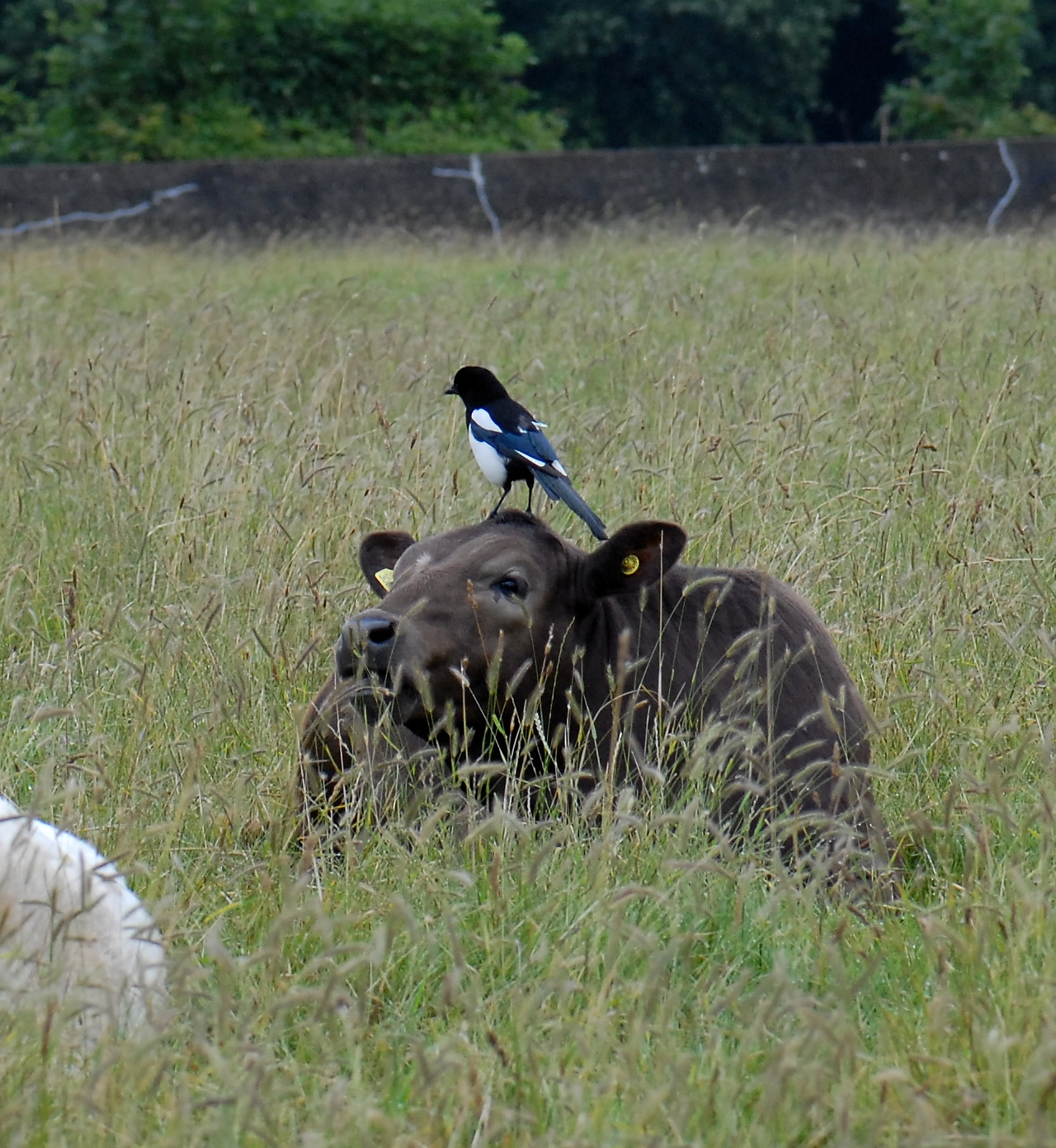
A lone magpie looking for breakfast provides personal grooming for members of the herd